
The checkpoint guard barely looked at Ellie’s papers before waving her through.
“Welcome back to Seattle, ma’am. Quarantine Zone 7 is two miles north. You’ll need to register within twenty four hours.”
Ellie nodded, throat too tight to speak. She shouldered her pack and walked past the barricade, into the city she’d sworn she’d never see again.
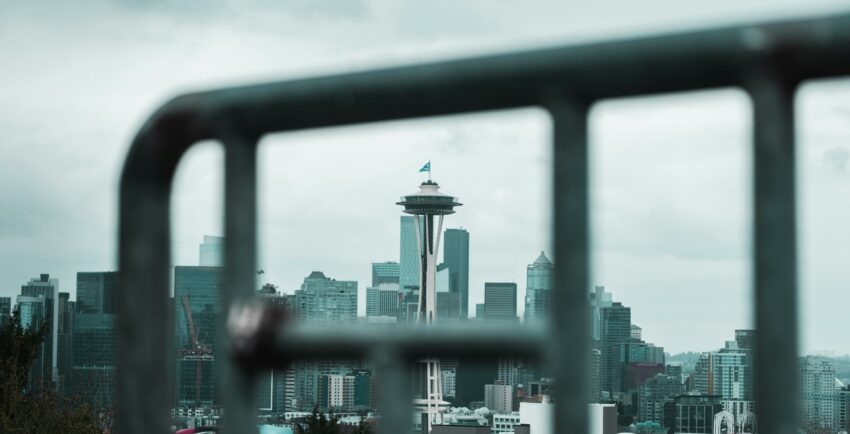
Seattle looked like a corpse pretending to be alive. The Space Needle still stood, somehow that felt obscene, that something so frivolous had survived when so many hadn’t. The streets were cleaner than she remembered, but emptier. No traffic jams. No crowds. Just scattered clusters of people moving purposefully from one fortified building to another, faces covered, eyes down.
Seven years. Seven years since she’d left this place, half-dead and entirely broken. Seven years since she’d looked back at the house on Meridian Street and promised herself she’d rather die than return.
And yet here she was, walking north, her feet remembering the route even as her mind screamed at her to turn around.
BEFORE
They’d called themselves the Meridian Five, which was pretentious and perfect and exactly the kind of thing you did when you were twenty three and thought you’d be young forever.
Ellie, Jennie, Bobby, Logan, and Dedee. Best friends since college, inseparable through graduation, still crammed into the same massive rental house in Capitol Hill because none of them wanted to grow up enough to live alone. The house on Meridian Street was chaos, perpetually messy, always loud, full of inside jokes and communal dinners and the kind of deep, easy love that comes from choosing your family.
“We’re like the Friends cast,” Dedee had said once, sprawled across the couch during one of their marathon TV nights.
“And actually funnier,” Logan added, stealing popcorn from Bobby’s bowl.
“And with actual problems,” Jennie said, though she was laughing.
Ellie had looked around at all of them, her people, her home, and felt so lucky it hurt.
That was March 2027.
By April, the world was ending.
The virus had a medical name that nobody used. Everyone just called it the Sweep, because that’s what it did, swept through populations like a scythe through wheat. The mortality rate was fifty three percent. No cure. No vaccine. No pattern to who lived and who died.
Just randomness and grief.
The Meridian Five had hunkered down immediately. They’d stocked up on supplies, sealed the house, made a pact: they’d survive this together. Whatever happened, they’d take care of each other.
For the first month, it worked.
They rationed food. Set up a rotation for supply runs. Bobby, who’d been pre med before dropping out, became their unofficial medical expert, monitoring everyone’s temperatures twice daily. Logan handled security, reinforcing doors and windows. Jennie managed inventory with spreadsheets that would have made a military quartermaster weep with joy. Dedee kept morale up with terrible jokes and elaborate meals made from canned goods.
And Ellie? Ellie was the heart. The one who noticed when Logan was spiraling. Who held Jennie when she cried about her parents in Florida, unreachable and possibly dead. Who played cards with Bobby during his insomnia nights. Who laughed at Dedee’s jokes even when they weren’t funny.
They were going to make it. They had to.
Then Jennie got sick.
It started with a cough. Just a small thing, barely noticeable. But in a world where a cough could be a death sentence, it might as well have been a gunshot.
“I’m fine,” Jennie insisted, but her temperature was 99.8 and climbing.
They isolated her immediately, moved her to the basement, left food outside her door, tried to pretend this wasn’t happening. Bobby checked on her through the door, monitoring symptoms, hoping desperately it was just a cold, just stress, just anything but the Sweep.
By day three, Jennie was at 104 degrees and hallucinating.
That’s when the house meeting happened.
Ellie would remember it forever: the five of them, four, really, with Jennie downstairs, sitting around the kitchen table in the dark because they were conserving electricity. The silence was so thick it felt like drowning.
“We need to talk about contingencies,” Logan said finally.
“She’s going to be fine,” Ellie said automatically.
“Ellie.” Logan’s voice was gentle, which was worse than if he’d been harsh. “The mortality rate…”
“I know the mortality rate!”
“Then you know we need to plan. If Jennie doesn’t make it, we need to…”
“Don’t.” Ellie’s voice cracked. “Don’t finish that sentence.”
But Bobby did. “We need to make sure the rest of us survive.”
The words hung there, poison in the air.
“What are you saying?” Ellie asked slowly.
Dedee wouldn’t meet her eyes. Logan studied his hands. Bobby took a deep breath.
“Our supplies are running low. The grocery stores are being looted. The government quarantine zones are only taking healthy people. If we’re going to make it, we need to be strategic.”
“Strategic,” Ellie repeated flatly.
“The quarantine zone in Bellingham is accepting refugees,” Jennie said, no, wait, it was Logan speaking. Ellie’s brain was short-circuiting. “They’re doing health screenings. If we leave now, we can get in. But if we wait, if any of us get sick…”
“You want to leave Jennie.”
Silence.
“You want to leave Jennie to die alone in our basement while we run away to save ourselves.”
“It’s not like that,” Dedee said, but her voice was small.
“Then what is it like?”
More silence. Then Bobby, who’d been Ellie’s friend the longest, who’d helped her move into this house, who’d held her hair back when she was sick and called her his sister, said:
“She’s probably going to die anyway. We don’t have to die with her.”
Ellie stood up so fast her chair fell over.
“Get out.”
“Ellie…”
“GET OUT!”
But it was her house too. Legally, the lease was in Jennie and Logan’s names. And Jennie was in the basement, dying, with no say in anything anymore.
They didn’t leave that night. But the pact was broken. The family was shattered. And Ellie knew, with terrible certainty, that she was now alone in a house full of people.
Jennie died on day seven.
Ellie found her in the morning, or what she thought was morning; time had lost all meaning. Jennie was curled on her side in the basement, and for a moment, Ellie thought she was sleeping. Then she saw the stillness, the wrongness, the way a body looks when there’s nothing left inside it.
She didn’t scream. Didn’t cry. Just sat next to Jennie’s body and held her cold hand.
The others came down eventually. Bobby checked for a pulse with clinical detachment. Logan talked about disposal protocols. Dedee cried silently in the corner.
They burned Jennie’s body in the backyard that afternoon, along with everything from the basement. It was illegal, probably, but nobody cared anymore. The smoke rose black and thick, and Ellie thought: This is what goodbye looks like in the apocalypse.
That night, the remaining four sat at the kitchen table again.
“We leave tomorrow,” Logan announced. “For Bellingham. They’re still accepting refugees.”
“What about Jennie’s family?” Ellie asked. “Someone should tell them. Call them.”
“Phone lines are down,” Bobby said. “And they’re in Florida. If they’re even alive…”
“Someone should tell them,” Ellie repeated.
“We will. Once we’re safe. Once we get to Bellingham and can…”
“You’re not going to tell them.”
“Ellie, we’re trying to survive here.”
“By abandoning everything that makes us human?”
Logan slammed his hand on the table. “Don’t you dare judge us! We’re doing what we have to do! Jennie’s dead, and we can’t save her, but we can save ourselves!”
“Is that what you’ll tell yourself?” Ellie asked quietly. “When you’re safe in Bellingham and I’m dead in a ditch somewhere? That you did what you had to do?”
Dedee finally spoke up. “Why would you be in a ditch? You’re coming with us.”
Ellie laughed, a hollow sound. “Am I?”
“Of course you are. Ellie, we’re still friends. We’re still…”
“Friends don’t leave friends to die alone.”
“She wasn’t alone,” Bobby said. “You were with her.”
“And you weren’t.”
The accusation landed like a slap. Bobby’s face hardened. “I was protecting myself. Protecting us. I did everything I could for Jennie, but I’m not dying for someone who was already gone.”
“She wasn’t gone when you decided to leave.”
“She was ninety percent dead! The math doesn’t change because you’re sentimental about it!”
“Math.” Ellie stood up. “We’re talking about our friend, and you’re doing math.”
“Grow up, Ellie!” Logan shouted. “This is the world now! You either adapt or you die! We’re leaving tomorrow, and you’re coming with us, and that’s final!”
“No.”
They all stared at her.
“No?”
“I’m not going with you. I’d rather take my chances alone than spend another second with people who think love is a math equation.”
“You’re being ridiculous,” Dedee said, but she sounded uncertain.
“Maybe. But at least I’ll be able to look at myself in the mirror.”
She went upstairs, locked her bedroom door, and waited for morning.
They left without her.
Ellie woke at dawn to the sound of the front door closing. She ran to the window and watched them load Bobby’s car, her friends, her family, driving away without looking back. Dedee glanced at the house once, hand raised like she might wave, but Logan said something and Dedee got in the car.
And they were gone.
Ellie stood at the window until the car disappeared. Then she sat on her bedroom floor and finally, finally cried.
She stayed in the house for three more days, eating the food they’d left behind (how generous), sleeping in Jennie’s bed because her own felt too lonely. On the fourth day, she packed a bag, locked the front door, and walked away from Meridian Street.
She swore she’d never come back.
NOW
The house looked smaller than Ellie remembered.
She stood across the street, staring at the place that had been home, then hell, then a grave she’d escaped. Someone had painted it a cheerful yellow, grotesque, really, given what had happened there. The garden was overgrown but alive. Flowers, even. Like the house was trying to pretend it had never been a tomb.
Ellie’s hand trembled as she pulled the letter from her pocket. She’d read it so many times the paper was soft as cloth.
Ellie,
I don’t know if this will reach you. I don’t even know if you’re alive. But I’m dying (cancer, not the Sweep, lucky me), and I need to tell you something before I go.
We were wrong. I was wrong. We left you, and we left Jennie, and we told ourselves it was survival, but it was just cowardice. I’ve thought about it every day for seven years. Every single day.
The others are gone too, Logan died in Bellingham during the second wave. Bobby’s in Portland, married with kids, and he never talks about before. Dedee’s in Phoenix. We don’t speak.
I’m the only one left in Seattle. And I’m dying in the house on Meridian Street because I bought it three years ago. Maybe as penance. Maybe because I’m an idiot.
I know you swore never to come back. But if you do, if you’re alive to read this, I want you to know: you were right. About everything. We broke something that couldn’t be fixed. And I’m sorry.
There’s a key under the blue pot on the porch. It’s your house now. I left it to you in my will. Maybe you’ll burn it down. Maybe that’s what it deserves.
I’m sorry, Ellie. I’m so, so sorry.
– Jennie’s mom (she’s alive, by the way. Florida made it through better than most. She knows what happened. She forgives us. I don’t know how.)
The letter wasn’t signed. Ellie didn’t know which one of them had written it. The handwriting was shaky, hard to read. Logan, maybe? Or Dedee?
It didn’t matter.
She crossed the street slowly, like approaching a wild animal. The blue pot was exactly where the letter said, faded and cracked but still there. She lifted it with shaking hands.
The key was underneath.
The inside of the house smelled like dust and lavender. Someone had cleaned recently, probably a lawyer, handling the estate. The furniture was different, new, but the bones of the house were the same. Same creaky third step on the stairs. Same window that never quite closed in the living room. Same kitchen where they’d had their terrible meeting.
Ellie walked through it like a ghost tour of her own life.
In the basement, there was nothing to mark where Jennie had died. Just concrete floor and storage boxes. Clean. Sanitized. Erased.
Ellie sat on the basement steps and finally let herself remember all of it. The good parts, the laughter, the late nights, the feeling of being loved and safe. And the bad parts, the fear, the betrayal, the loneliness of being left behind.
They’d all survived. That’s what the letter said. Logan died later, but the rest made it. They’d done their math, made their calculations, and it had worked.
Except it hadn’t. Because seven years later, they were scattered and broken and dying alone, just like they’d been so afraid of.
Upstairs, Ellie heard something. Rain, she realized. Starting to fall on the roof in steady, rhythmic drops.
She climbed back upstairs and walked to the living room window, the one that never quite closed. Rain was falling harder now, washing the streets, making everything grey and clean.
Somewhere in Phoenix, Dedee was probably alive, probably fine. In Portland, Bobby was probably tucking his kids into bed. And whoever had written the letter was dead now, bones in the ground, joining Jennie and Logan in whatever came next.
Ellie pressed her forehead against the window glass, cold and wet.
She’d come back. To the place she swore she’d never return. To the house that had broken her.
Why?
Maybe to prove she could survive it. Maybe to say goodbye properly. Maybe because she was tired of running from ghosts.
Or maybe because despite everything, the betrayal, the pain, the seven years of carrying this wound, part of her still remembered what it felt like to be loved here. To belong. To believe that the Meridian Five would last forever.
That part was dead now. But it had been real once. And maybe that was enough.
The rain fell harder, drumming on the roof, washing the house clean. Through the window, Ellie could see the street, the neighborhood, the city trying to rebuild itself from the ashes.
Seattle had survived. Her friends had survived, then scattered, then died one by one.
And she’d survived too. Not because she’d made the smart choice or done the math. But because she’d chosen to stay human, even when it hurt. Even when it was stupid. Even when everyone else ran.
Was that victory? She didn’t know.
But she was here. Still standing. Still breathing.
Ellie pulled out her phone, everyone had phones again now, though the networks were spotty, and stared at the blank screen. She could call Dedee. Could find Bobby’s number somehow. Could reach out to the people who’d left her to die.
But what would she say?
I forgive you? She wasn’t sure she did.
I hate you? That wasn’t quite right either.
Maybe: I survived you. And that has to be enough.
She put the phone away.
Tomorrow, she’d decide what to do with the house. Sell it, probably. Use the money to keep surviving, keep moving forward. She couldn’t live here, too many ghosts. But she could let it go properly this time, without bitterness.
Tonight, though, she’d just sit here in the house on Meridian Street, watching the rain fall, remembering what it felt like to be young and stupid and so loved it hurt.
The rain kept falling, steady and sure, washing away seven years of dust and anger and grief. And Ellie sat by the window that never quite closed, crying and laughing and somehow, impossibly, feeling lighter than she had in years.
She’d come back to the place she swore she’d never return to.
And she’d survived it.
That was enough.
That was everything.